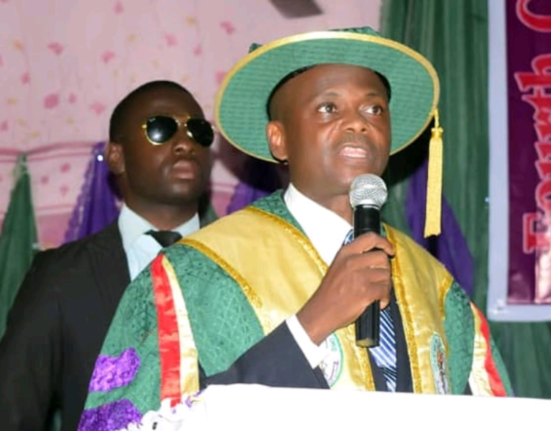
At a time when most Nigerian households are under tremendous pressure from the high cost of living, and unemployment and underemployment rates remain very high, Wesley University, Ondo State, has taken a path many consider rare. The university has recently announced a reduction in school fees. This decision by Wesley management to approve a downward review for the 2025/2026 session stands out as a bold act of compassion and leadership. It is also uncommon in a country where tuition fees have consistently risen, regardless of the state of the economy.
For Vice-Chancellor Prof. Samuel Obeka, the choice was not about numbers or revenue. It was a moral duty. At the institution’s 14th convocation ceremony, he explained that the move was driven by the desire to ensure that “no deserving learner is denied the opportunity to acquire quality education.” In simple terms, Wesley saw the suffering in the land and responded with heart.
Experts say this kind of decision is uncommon among private universities where operational costs are high, and profits often take centre stage. However, Wesley University—owned by the Methodist Church of Nigeria—appears more concerned about shaping futures than protecting financial margins. Education analysts at the event described it as “a leadership decision rooted in empathy,” noting that Wesley’s model could inspire other institutions to rethink their priorities.
Prof. Obeka admitted that the economy has not spared universities either. Still, the management chose to absorb some of the financial pressure rather than pass it fully to students and their parents. “This balanced fee review reflects our dual mandate of compassion and quality assurance,” he said. He also highlighted that only specialised programmes such as Medicine, Nursing, Law, and some Allied Health Sciences received slight upward adjustments to meet accreditation requirements and specialised facility needs.
Stakeholders say the gesture is already yielding results. The university has witnessed a sharp rise in student enrolment, boosted by the NUC’s approval of new programmes. Staff members, parents, and alumni described the change as a “huge relief” and a “timely intervention.”
And then there are students like Ayomide Olapade, the best graduating student with a CGPA of 4.91, who reminded the audience that greatness comes from focus and resilience. Her story represents the very learners Wesley is trying to protect—brilliant minds whose only barrier is financial difficulty.
In a harsh economy, Wesley University has shown that compassion is still possible. More importantly, it has offered a quiet challenge to other institutions: do not forget the people education is meant to serve.