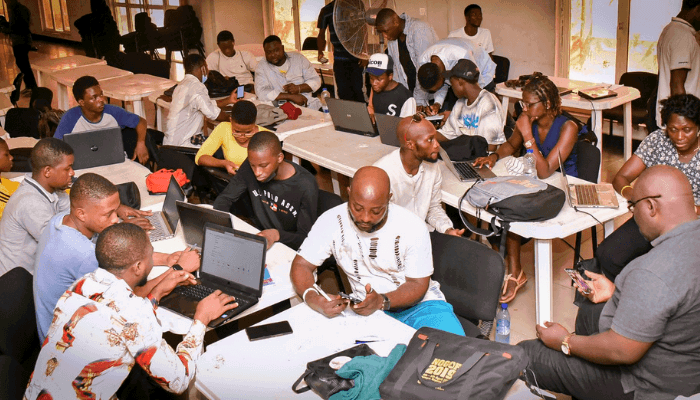
The Federal Government has unveiled a plan to train five million Nigerian youths in globally relevant skills over the next four years, aiming to reduce unemployment and prepare the workforce for both local and international opportunities.
Minister of Education Dr. Tunji Alausa announced this initiative during the 2025 Quarterly Citizens and Stakeholders Engagement on the Nigeria Education Sector Renewal Initiative (NESRI) held in Abuja.
He stated the government’s commitment to transitioning Nigeria from a resource-based to a knowledge-driven economy by equipping young Nigerians with practical skills.
As part of the strategy, the government has upgraded 38 federal and state technical colleges and introduced a dual-training model where students spend 80% of their time on practical training and 20% on classroom instruction.
The initial phase targets 650,000 enrollees, with the first cohort expected to commence training between March and April 2025.
Graduates will receive entrepreneurial grants to support their ventures.
To further address the digital skills gap, the government plans to launch a Digital Training Academy in June 2025, offering free six-month training programs in areas such as software development, cybersecurity, and artificial intelligence.
This initiative aims to fill nearly two million digital sector job vacancies, as identified by UNESCO.
The NESRI framework also focuses on improving literacy, data digitisation, and curriculum reform.
Efforts are underway to reintegrate out-of-school children, with 25,000 enrolled through NESRI and 4,000 Tsangaya teachers trained to support inclusive education.
The LUMINAH Girls’ Dual Initiative aims to enable one million girls to complete their basic education by 2030 across 12 pilot states.
Also, the government is working towards digitising national examinations, with plans for the National Examinations Council and the West African Examinations Council to begin computer-based tests by November 2025, targeting complete digitisation by 2027.
The Minister of State for Education, Prof. Suwaiba Ahmad, emphasised the importance of Technical and Vocational Education and Training (TVET) in addressing Nigeria’s skills gap and reducing the country’s reliance on foreign workers.
Senator Muntari Dandutse, Chairman of the Senate Committee on Tertiary Institutions and TETFund pledged legislative support for these reforms.
In a related development, Dr Alausa inaugurated the national policy on bullying in Nigerian schools, aimed at instilling discipline and improving the education sector and society at large.