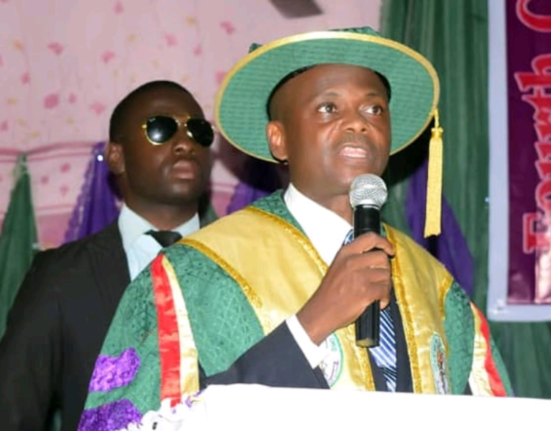
Ayankola Ayanwuyi, Yorùbá Cultural Heritage Expert
A fresh conversation is emerging across Africa’s education space, coming from an unexpected place — the ancient Ifa corpus. Cultural heritage scholar, Ayankola Ayanwuyi, says Africa may be sitting on one of the richest knowledge systems in the world, but has not fully tapped into it. According to him, Ifa is not just a spiritual guide; it is a complete intellectual archive waiting to be unlocked.
Speaking at the UNESCO International Youth Forum on Creativity and Heritage along the Silk Roads in China, Ayanwuyi explained that Ifa carries deep lessons that modern education can learn from. He argued that the system covers a wide range of fields — philosophy, medicine, governance, engineering, literature, agriculture, ecology, mathematics and even decision science.
Experts say this cross-disciplinary nature makes Ifa a powerful model for redesigning African curricula. Instead of teaching subjects in isolation, Ifa teaches knowledge as a connected web — where ethics links to environment, where history links to governance, and where numbers link to behaviour and outcomes. This, they argue, is systems thinking at its finest.
Ayanwuyi insists that Africa must correct the long-standing misconception that Ifa is merely a spiritual or divination practice. “Its body of knowledge is comprehensive,” he said. “Every society has enough intelligence to grow, if only it takes its indigenous knowledge seriously.”
One of the most surprising revelations is that the Ifa system operates with binary logic — the same principle that underpins modern computer science. Long before digital technology, Ifa used a coded structure of ones and zeros, patterns, probability and statistical reasoning to guide decision-making. Concepts such as Boolean algebra, matrices, memory organisation, and coding were embedded in Ifa centuries before computers became mainstream.
For many education stakeholders, this is a game-changer. It suggests that African children can learn digital thinking, logic, environmental ethics and cultural literacy from a knowledge system built on African soil — not borrowed from foreign models.
Ayanwuyi, founder of Dundun Centre and Nigeria’s delegate at the UNESCO forum, believes this shift could spark a new education revolution. “We can innovate from our indigenous systems,” he said. “These are innovations that meet our geographical needs as a people.”
For Africa, the message is clear: the future of education might just lie in the wisdom of the past — in a system where creativity, ethics, ecology, technology and identity are woven into one fabric.