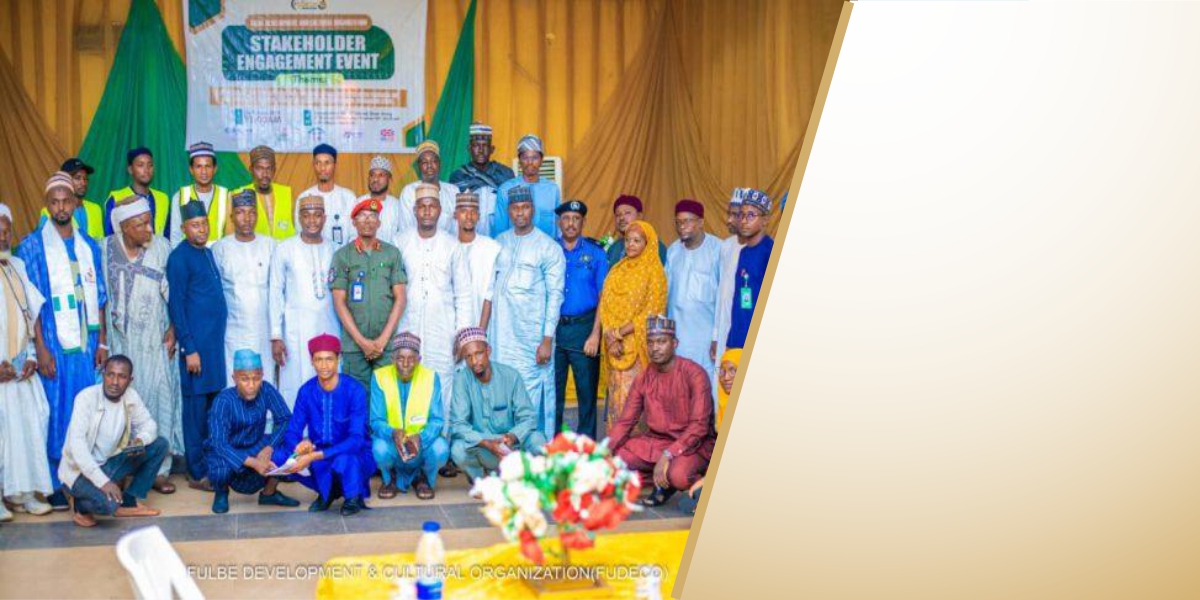
The Fulbe Development and Cultural Organisation (FUDECO), in collaboration with Supporting Pastoralism and Agriculture in Recurrent and Protracted Crises (SPARC), has trained and empowered approximately 250 pastoral women residing in Nasarawa State, as part of efforts to address the issues of crime in the state.
The State Chairman of FUDECO, Muhammad Habib Hussaini, disclosed a Stakeholders’ Engagement event which was held in Lafia, the state capital. The event was tagged “Consolidating The Outcomes of The IDRC-SPARC GES Research Findings On The Economic Empowerment of Pastoralist Women in Nasarawa State.”
Speaking during the stakeholders’ engagement, Hussaini explained that the beneficiaries, who were taught various skills including making bags, soaps, shoes, perfume, vaseline, palm oil, and yoghurt, gained startup capital and several platforms to showcase their businesses to the world. He narrated that the association had embarked on a research project to determine the best way to train and empower pastoralist women in the state, due to the challenges they faced, including limited access to social services, insecurity, marginalisation, exclusion, resource conflicts, and livestock diseases, among others.
Hussaini added that the research also focused on critical issues such as gender equality, social inclusion, and women’s empowerment, expressing optimism that, as a result of the engagement, stakeholders would join hands with FUDECO to work towards addressing the challenges being faced by pastoralist communities.
He further explained that while the funding for the empowerment programme was facilitated by the International Development Research Centre and SPARC, the UK Aid supported the research project, which revealed the best ways to empower pastoralist women in the state.
While commending the Lead Researcher, who is a Senior Lecturer at the Department of Sociology, Federal University of Lafia, Dr Usman Ibrahim, for his untiring efforts which led to the success of the research project, the FUDECO chairman expressed delight that the results from the research showed that the empowerment programmes organised by the association positively affected the lives of people in the study area.
“The Fulbe Development and Cultural Organisation embarked on the training and empowerment of the over 250 pastoralist women who were selected from across the 13 LGAs of the state to enable them to have skills that could help to put food on their tables and generally improve their livelihoods. Based on the Lead Researcher’s findings, over 70 per cent of pastoralist women in Nasarawa State did not get a formal education. This was why the association deemed it fit to help them acquire skills so that they would not consider crime as an option for their daily survival,” he explained.
He, therefore, appealed to the Federal Government, the Nasarawa State Government, and other good citizens of the country to support the organisation in every way possible, enabling them to reach more pastoralist women in rural communities.
On his part, the Lead Researcher, Dr Usman Ibrahim while presenting his findings and recommendations on the matter, explained that FUDECO came up with the plan to train and empower the women for them to be financially stable, and to enable them contribute to the growth and development of the state and country at large. He explained that during the research, all the respondents agreed that the empowerment programmes increased their standard of living because they can now earn enough money from it and can even save and invest money, adding that it is a giant stride towards becoming self-sufficient, especially in patriarchal societies where women are primarily dependent on men for survival.
He added, “Findings show that over 70 per cent of the pastoralist women do not have access to education, healthcare, portable drinking water and land. Furthermore, they face high discriminatory practices leading to their low socio-economic status. This calls for combined efforts to support pastoralist women and promote women’s equality at all levels.”
The paper recommended that pastoralist women should be allowed to attend school, and efforts should be made to create awareness in the general society about embracing pastoralist women as human beings.
“We are calling on both the state government, federal government and donor agencies to support the skills acquisition of pastoralist women and include them in all their empowerment programmes as part of social inclusion. Government and its agencies like the Nasarawa State Universal Basic Education Board should also sincerely look at the issue of nomadic education with a sense of responsibility in terms of building new structures, chairs and tables in addition to posting qualified teachers with a good monitoring scheme”, he concluded.
According to reports, representatives from various security agencies in the state, traditional and religious leaders, Fulani women, youth groups, and other stakeholders attended the stakeholders’ engagement event.