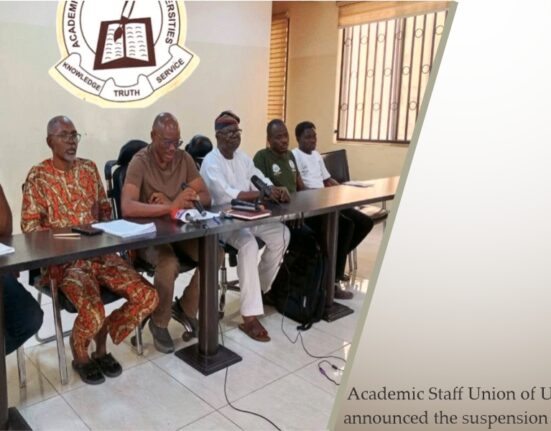
The Academic Staff Union of Universities (ASUU) has expressed deep concern over the Federal Government’s continued failure to honour agreements aimed at revamping Nigeria’s university system.
Speaking at a press conference in Abuja, the newly elected ASUU President, Professor Chris Piwuna, described the government’s inaction on critical matters as a significant stumbling block to the growth and development of the country’s education sector.
He lamented the lack of progress on several longstanding issues, including the non-implementation of various Memoranda of Understanding (MoUs) and Memoranda of Action (MoAs) entered into since 2013, as well as the incomplete execution of the 2009 FGN/ASUU Agreement.
According to Professor Piwuna, the slow pace of implementing the 2009 agreement is discouraging. Key issues he identified include the failure to conclude the renegotiation of the agreement based on the Nimi Briggs Committee’s 2021 draft, non-payment of salaries withheld during the 2022 strike, and the continued exclusion of staff on sabbatical, part-time, and adjunct appointments from payroll due to the Integrated Payroll and Personnel Information System (IPPIS).
He also raised the alarm over the non-remittance of third-party deductions, such as check-off dues and cooperative contributions, as well as the poor funding for the revitalisation of public universities and the persistent non-payment of Earned Academic Allowances (EAA). ASUU further criticised the establishment of new universities by the Federal and State Governments without adequate funding plans in place.
The ASUU President decried the government’s failure to reconstitute governing councils for several universities, describing it as a deliberate attempt to weaken university autonomy. He reiterated the union’s call for the full adoption of the University Transparency and Accountability Solution (UTAS) as a credible, homegrown alternative to IPPIS.
Professor Piwuna emphasised that education remains a critical pillar for national development, warning that the continued neglect of these issues could lead to further disruption in the university system.
He also condemned what he termed undue political interference in university governance and appointments, arguing that such practices erode institutional integrity and undermine the quality of tertiary education in Nigeria.
ASUU concluded by urging the government to take immediate and sincere steps to address these concerns, noting that doing so is essential for restoring industrial harmony and repositioning Nigerian universities for effective service delivery and global competitiveness.