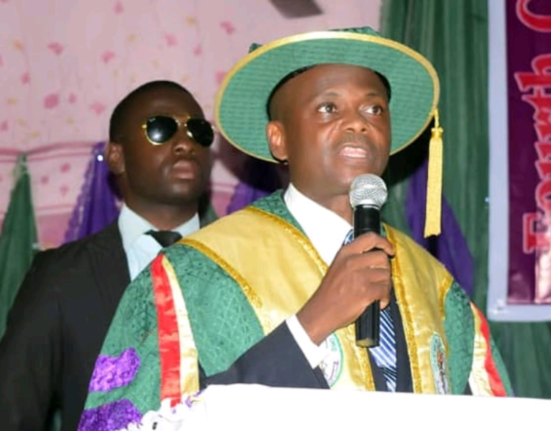
Dr. Tunji Alausa, Minister of Education
Nigeria is gradually moving from being a country that loses talent to one that strategically exports skilled professionals to the global market. This new direction was highlighted when the Federal Government announced a partnership with the Giessen-Friedberg Chamber of Commerce (GCOC) in Germany to train and deploy Nigerian graduates and technical students to fill the skilled labour gaps in Europe’s largest economy.
According to the Minister of Education, Dr Tunji Alausa, the initiative aims to ensure that Nigerian youths trained through Technical and Vocational Education and Training (TVET) programmes can meet international labour standards while also supporting local industries. “This is not brain drain,” he said, “but a structured export of skills and expertise.”
Under the partnership, Germany will assess and select qualified Nigerian trainees for specialised vocational placements. These trainees will undergo dual training, combining classroom theory with hands-on experience in various industries. A first batch of 18 Nigerians has already been selected to learn the German language and participate in a three-year vocational training programme in Germany.
The move comes as part of the Federal Government’s broader plan to train one million Nigerian youths under its TVET scheme. Already, 250,000 participants have begun their training free of charge, with funding support from the World Bank to equip technical colleges with modern workshops. The government reports that enrollment in technical colleges has surged by 400 per cent, indicating a renewed interest in practical skills development.
Experts in education and labour have praised the development, adding that the partnership represents a strategic balance between migration and national growth. Dr Matthias Leder, CEO of the GCOC, noted that Germany faces a severe shortage of skilled technicians and artisans, and Nigeria’s growing pool of trained youths could help bridge that gap.
Labour analysts, however, caution that Nigeria must ensure the programme also benefits its local economy by creating strong re-entry pathways for returning professionals. “We must turn migration into knowledge exchange, not just workforce export,” said one vocational education expert.
If well managed, this partnership could redefine Nigeria’s place in the global labour market — not as a source of cheap labour, but as a hub of globally competitive talent.