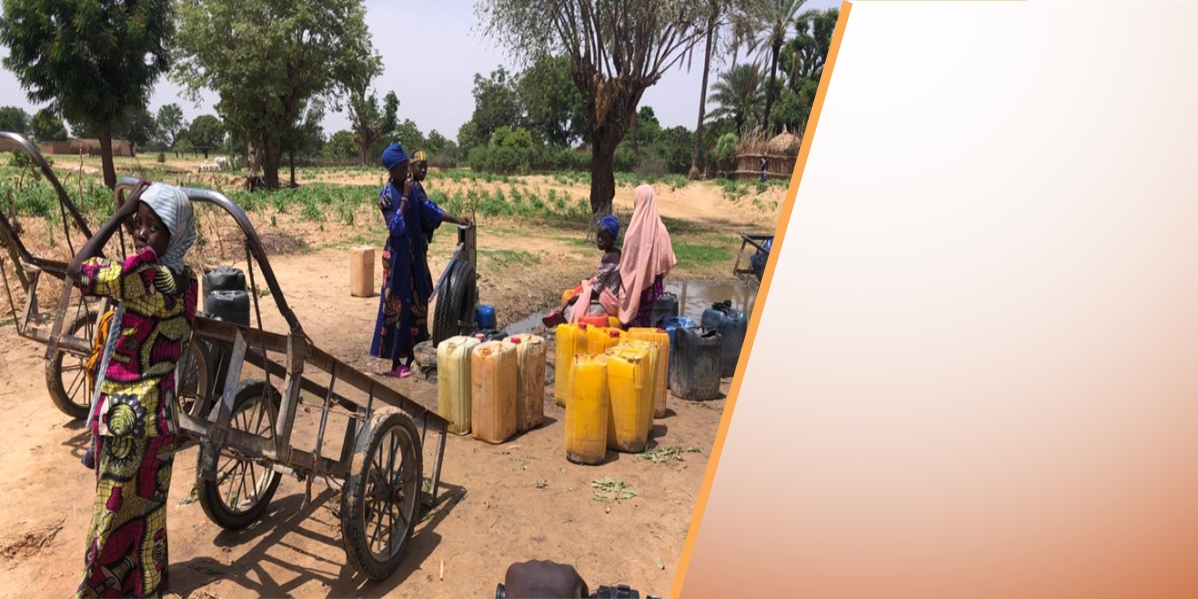
For the people of Dutsen Bakoshi in Shanono Local Government Area of Kano State, water is not just a daily need — it is a burden that has shaped their way of life for many years. The community of over 40,000 people depends largely on seasonal earth dams. Once the rainy season ends, the struggle begins, and for many families, it is the girl-child who pays the highest price.
Every morning, girls as young as 10 leave their homes, sometimes trekking for hours in search of water. For them, school becomes secondary. “Our children cannot attend school fully because they must fetch water first,” lamented Malam Musa Isyaku, a father of six. “We know education is important, but water is life.”
The impact is clear: many girls drop out of school completely. Sadiqa Tijjani, 15, stopped attending classes in JSS2. “I wanted to continue school, but every day I must look for water for my family. By the time I return, classes are over,” she said, her voice heavy with regret.
Mothers in the community admit that it breaks their hearts to see daughters abandon education, but survival comes first. “We hate it, but what do we do?” asked Malama Asma’u Umar. “If there is no water at home, no family can survive. Our girls walk long hours because buying water is too expensive.”
A 25-litre jerry can of water sells for as high as ₦500 during the dry season, a cost many families simply cannot afford. “Imagine spending ₦60,000 every month on water alone. That is what some families face,” said Habiba Tijjani, another resident.
Local leaders attribute the failure of borehole projects to the rocky landscape. “We have drilled 200 meters without finding water,” explained Abba Muhammad Idris, the ward councillor. “It is not that the government is not trying, but our topography is difficult.”
Education experts say the crisis in Dutsen Bakoshi mirrors challenges across northern Nigeria, where access to basic resources continues to push children, especially girls, out of school. “Water is an education issue, a health issue, and a development issue,” argued Dr Amina Hassan, a lecturer at Bayero University, Kano. “Without solving water problems, the government cannot solve out-of-school problems.”
UNICEF reports that Nigeria already has the highest number of out-of-school children in the world — over 10 million. Water scarcity compounds the problem. “It is a hidden driver of school dropout,” Dr Hassan added.
Nigeria is not alone in this challenge; other African countries face similar problems. Ethiopia faced similar water shortages in rural communities, which forced girls out of school. However, the government partnered with international NGOs to build solar-powered boreholes and small-scale water treatment plants, ultimately addressing the issue. Kenya has also implemented rainwater harvesting projects in schools, resulting in a reduction in absenteeism among girls.
Stakeholders believe Nigeria can learn from these models. “It is not enough to keep drilling failed boreholes,” said environmental activist Abdulrahman Yusuf. “There must be innovation — solar-powered systems, rainwater storage, and community-based maintenance.”
Back in Dutsen Bakoshi, the community’s legendary rock stands tall, but beneath it lies the harsh truth of deprivation. For fathers like Malam Saidu Turaki, the dream is simple: “We want our daughters to be in classrooms, not carrying jerry cans.”
As Kano State and federal authorities search for solutions, the future of thousands of girls hangs in the balance. Education cannot thrive where survival is uncertain. Moreover, in Dutsen Bakoshi, the search for water is slowly drowning the dream of schooling. Unless the government acts with urgency to address the problem, a greater challenge lies ahead.