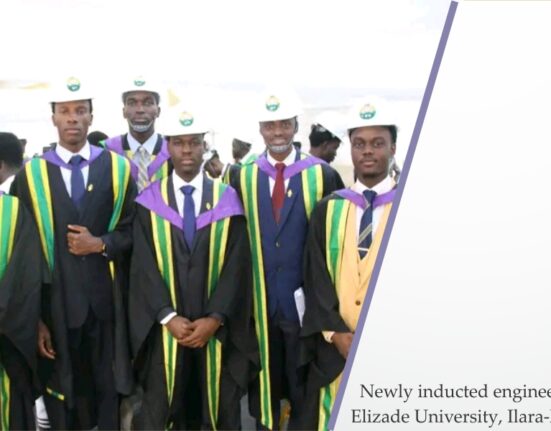
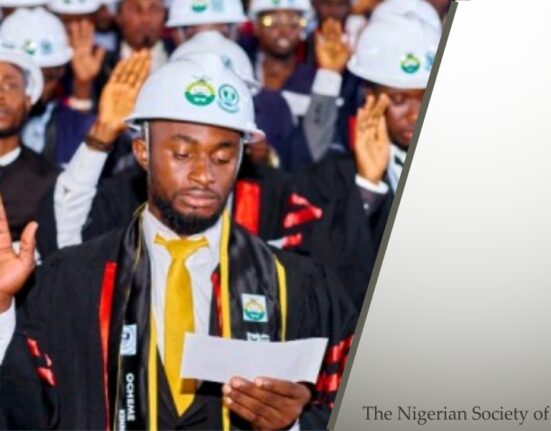
The Nigerian Society of Engineers (NSE) has called for a transformation in African engineering education to meet global standards while remaining rooted in local realities.
During a panel session at the 2025 Offshore Technology Conference (OTC) in Houston, Texas, NSE President Mrs. Margaret Oguntala urged increased investment in infrastructure, strategic partnerships, and digital tools to close the gap between academia and industry.
The African Content Collaboration Session, held on Wednesday, focused on “Local Content Development and Partnership for Africa’s Energy Sustainability,” according to the News Agency of Nigeria (NAN).
It focused on advancing engineering capacity and energy innovation across the continent.
Oguntala outlined key strategies for aligning African engineering education with international benchmarks.
She said these include curriculum and faculty development, stronger engagement with industry, accreditation processes, and fostering innovation.
She emphasised the importance of developing syllabi that reflect global best practices while building local talent pipelines.
“In Nigeria, we have begun implementing an Outcome-Based Education (OBE) system, which prioritises technical competencies over theoretical knowledge.
“This is a significant step forward for engineering education in Africa,” she said.
Oguntala highlighted Nigeria’s efforts toward global recognition, noting that the Council for the Regulation of Engineering in Nigeria (COREN) is a provisional signatory to the Washington Accord, an international agreement promoting outcome-based engineering education.
“This progress underscores the importance of government, academia, and industry collaboration.
“The government must be intentional in funding institutions, providing modern training facilities and equipment to ensure hands-on learning for engineering students,” she added.
In the spirit of regional collaboration, Oguntala revealed that Nigeria is mentoring engineering boards in Kenya and Ghana to adopt similar standards.
According to her, this aims to strengthen the continent’s engineering talent base.
She, however, said that inadequate funding remained a significant challenge.
“The Nigerian Content Development and Monitoring Board (NCDMB) is supportive.
“For example, an innovation hub is being developed in partnership with the University of Lagos, and we need more initiatives like this to expose students to emerging technologies,” she said.
Also speaking at the event, Mr. Walter Akpani, Managing Director of Providus Bank, stressed the importance of supporting Small and Medium Enterprises (SMEs) as key drivers of economic growth.
“SMEs are often overlooked in the oil and gas value chain, but they are crucial,” Akpani said.
“There is no one-size-fits-all financing template; institutions must understand the unique transactional dynamics of each SME.”
He noted that high naira-based financing costs hinder SME sustainability, advocating for more flexible funding options.
“Dollar-denominated financing, despite exchange rate concerns, may offer more affordability in the long run,” he added.
In a related presentation, Mr Emmanuel Emefienim, Managing Director of Premium Trust Bank, represented by Executive Director Mrs Bukola Awosanya, discussed financial de-risking strategies for the oil and gas sector.
“Banking is fundamentally about providing funds and ensuring repayment.
“Within the oil and gas sector, which has a complex value chain, financing models must be structured to manage or transfer risk effectively,” she said.
Awosanya described the African Energy Bank initiative as a promising model for pooled funding.
“Oil and gas projects typically require substantial, long-term Financing.
“Financial institutions must collaborate with energy firms and adopt structures that ensure timely access to funds and risk mitigation,” the managing director stressed.
She emphasised that long-term loans should be considered strategic assets on the balance sheet, adding that alternative financing instruments could be crucial in advancing sector development. (NAN)