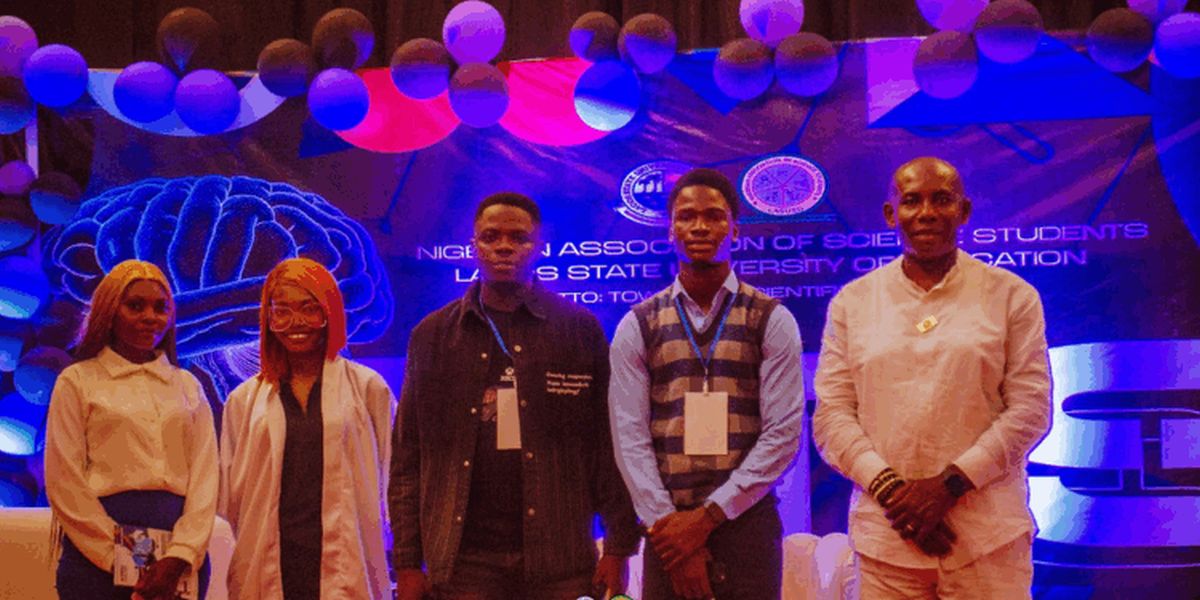
If life had a resume, “Bachelor’s degree” would be footnoted in italics and buried somewhere near the end. That was the unspoken message at the Lagos State University of Education during the Science Tech Summit (STS 3.0) hosted by the Nigerian Association of Science Students (NASS).
Themed “Beyond the Degree: Mastering Tech, Entrepreneurship, Creativity & Wealth Creation,” the summit brought together speakers from digital media, education consultancy, tech entrepreneurship, and supply chain strategy. Their collective advice was that it is no longer enough to graduate; you must evolve.
Let us start with Joan Aimuengheuwa, assistant editor at Techeconomy, who built her career before her final examinations were over. “Success is about learning and doing,” she said. “I started working while I was a student, just like you. I did not even want to do some of those things at first, but again, I did not let opportunities slide by. That is how I started.”
She recalled taking on roles that paid only enough for the data: no prestige or promise, just persistence. “Back then, I worked with a lecturer who had a company while also working at another media firm. I was juggling school, internships in the media space, data analysis, and everything else. You cannot survive in this space without being a good analyst or a good researcher.”
When asked what students need to succeed in the digital media space, her answer was direct: “Discipline. You cannot be a writer, editor, or analyst without patience. Your character is essential because it is your name that’s at stake here, not just your pay. Again, you need to learn SEO, networking, research, and utilise AI effectively. AI should look up to you, not the other way around.”
However, perhaps the most striking insight came from her early career reflection: “Do not wait till you are ready. Do not be afraid to start poorly. Do not be afraid to fail. My first boss was strict. She did not insult me, but when I made a mistake, it was as if she said, ‘How can you do this?’ I never told her, but in my head, I was like, ‘I am learning.’ However, I went through it. She taught me. Moreover, when I applied for my next job, my new boss said, ‘She came in highly recommended.’ Why? Because of my character.”
Pascal Orisakwe, the career strategist and supply chain manager at Beta Glass, took over. “Success,” he said, “is not how much money you have in your bank account. It is the ability to create value, to solve problems, and reward follows that.”
He warned students about mistaking noise for navigation. “Some people just want to get out of the house. They do not think of life after that certificate. That is one major challenge. You do not just jump into a career because your friend is doing it.” Pascal shared a harsh truth about adulthood. “Someone once said adulthood is a scam. However, it is only a scam if you are not prepared. Moreover, preparation means skills. It means understanding that AI, robotics, and the Internet of Things are already running the world. If you are not evolving, you are fading.”
For students willing to further their studies abroad, Janet Amosu, Business Development Manager at BWBS Education Consultants, pitched access to students at STS 3.0. “We do not charge for applications—100% free service. No payment for application processing, no payment for visa submission, no charges for interviews,” she said.
It sounded too good to be true, so when asked about the success rate, she doubled down: “Yes, 100% success rate. We offer scholarships of up to 50% for academically strong students. If you do not get a job nine months after graduation, we work with schools that refund 50% of your tuition and use the other 50% to re-enrol you.”
Her advice to those considering studying abroad? Start early. “Many students miss out because they did not start on time or were not aligned with their financial and academic realities. Stay informed. Trust the process.” And then there was Elias Roosevelt, founder and CEO of Payable. He added weight to the tech entrepreneurship part of the conversation, stressing that “building viable products in the financial tech space, not just talking about it, is highly important.”
Pascal, when asked if he would change anything in his career, said: “In all honesty, I do not think I would change anything. When you alter your yesterday, your today and tomorrow might not come out the way they should. The journey of life requires intentionality.”
He urged students at the STS 3.0 summit and beyond not to let emotions drive their decisions. “Discipline means waking up early. It means working late. You have to stay the course, even when it does not pay off immediately.”
In our world, where many are now obsessed with immediate returns, that might be the most radical advice of all. Beyond a panel, STS 3.0 served as a roadmap because, by 2025, you will no longer need another degree to succeed. You need audacity, resilience, and humility to learn from strict bosses and unpaid gigs. You need to build a name before you build a brand. Moreover, if you are lucky, you will realise that the classroom ends at the door, but your future does not.