

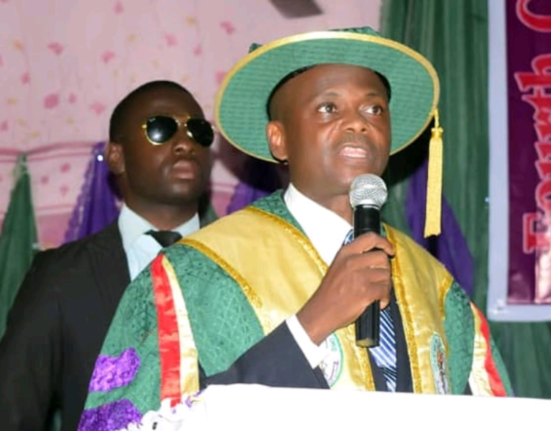
Prof. Adenike Oladiji (2nd right), FUTA’s Vice-Chancellor, at the institution’s 36th convocation ceremony
For years, Nigeria has looked to its universities with hope — hope that they will produce ideas, technologies, and solutions strong enough to lift the country out of its many challenges. Now, President Bola Tinubu has renewed that call, urging the nation’s academics to move beyond theories and deliver research that can truly solve problems.
Speaking at the 36th Convocation Ceremony of the Federal University of Technology, Akure (FUTA), the President, represented by NUC Executive Secretary Prof. Abdullahi Ribadu, stressed that Nigeria can no longer run universities as isolated islands. According to him, “the connection between our tertiary institutions and industry should be strengthened.” In simple terms, Nigerian universities must begin to view research as something that should translate into tangible products, companies, jobs, and ultimately, national development.
However, the question is: are the universities ready for knowledge commercialisation?
FUTA’s Vice-Chancellor, Prof. Adenike Oladiji, believes the institution is taking the proper steps. She announced that 1,030 postgraduate students graduated this year, including the university’s first set of PhDs in Renewable Energy Technology. She also highlighted FUTA’s impressive global visibility, with staff ranked among the world’s top two per cent of scientists and three research teams winning international grants worth over £136,000. These are significant achievements — but industry leaders argue they are not enough.
Across Nigeria, a frustration is growing. Many believe that universities produce brilliant research that ends up on library shelves, rather than in factories, farms, or hospitals. Oladimeji Olutimehin, co-founder of EWB Nigeria, provided a stark example: while a Nigerian university established a multimillion-naira space research centre, nobody had set up a centre devoted to solving the problems faced by Nigerian startups, farmers, or healthcare workers. “The way academia thinks is different from how industry thinks,” he said. “Companies spend money where they get value.”
In a country battling food insecurity, post-harvest losses, poor healthcare systems, and rising unemployment, universities are accused of chasing prestige-driven programmes instead of building innovation hubs that target real problems. Some institutions offering agriculture degrees do not even have functioning demonstration farms. Meanwhile, universities like Landmark reportedly produce the food consumed at Covenant University — demonstrating that self-reliance and industry-focused innovation are feasible.
For Nigeria to benefit from knowledge commercialisation, universities must shift from research for publication to research for impact. They must collaborate with industries, understand market needs, and build centres dedicated to agriculture, health technology, energy solutions, and entrepreneurship — not abstract projects disconnected from national realities.
Ultimately, commercialisation will only occur when universities begin to think like problem solvers. Moreover, perhaps this is Tinubu’s biggest message: Nigeria will grow faster the moment its ivory towers begin to innovate for the people, not for themselves.





Leave feedback about this