
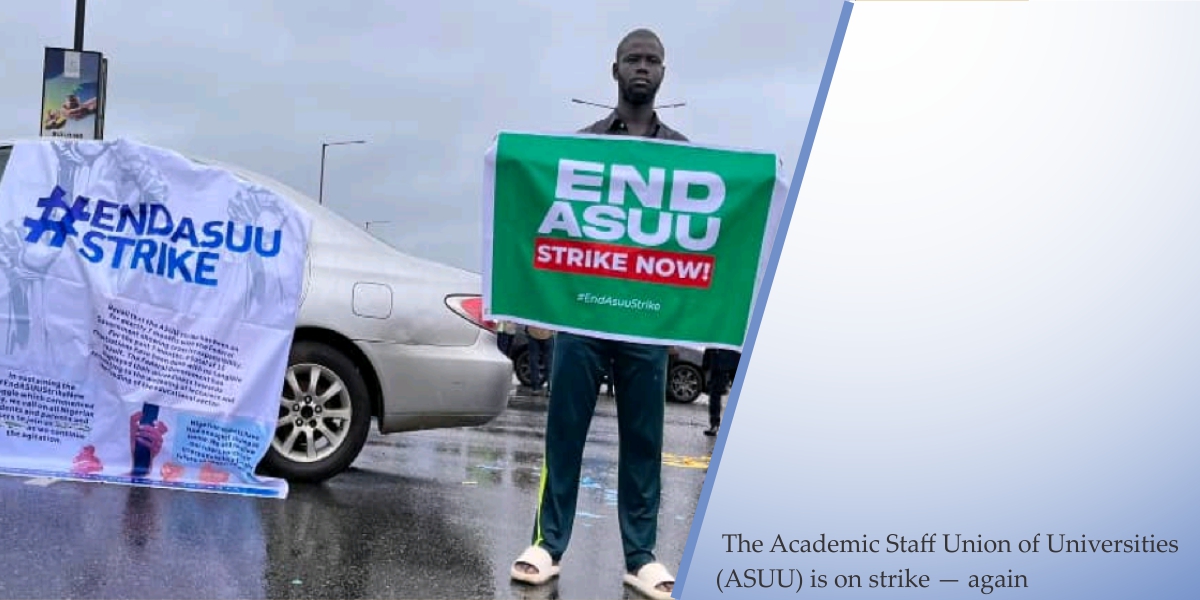
Once again, the gates of Nigeria’s public universities are locked. Lecturers have downed tools, students are stranded, and another academic calendar hangs in the balance. The Academic Staff Union of Universities (ASUU) is on strike — again. This time, it is a two-week warning strike declared on October 13, 2025, but Nigerians have seen this movie too many times to expect a happy ending.
For more than three decades, ASUU and the Federal Government have danced the same painful dance of broken promises and repeated betrayals. From the 1988 showdown that led to the union’s proscription by the General Ibrahim Babangida (rtd.) regime to the marathon nine-month strike of 2020 and the eight-month deadlock of 2022, the story has hardly changed. Agreements are usually signed, ignored, and forgotten until frustration boils over again.
The Cost of Endless Strikes
Sadly, the price of these recurring ASUU strikes is enormous. In the last ten years alone, public universities have lost more than 700 academic days to strikes. Behind those numbers lie wasted dreams — students spending five years to earn a four-year degree, parents groaning under financial and emotional strain, and employers growing increasingly sceptical of Nigerian graduates.
Education analysts say the cost goes beyond lost time. “Every strike deepens the decay in the system,” said Dr Emmanuel Nnadozie, an education economist. “Laboratories deteriorate, morale drops, and Nigeria loses competitiveness in global academic rankings.”
The Nigeria Labour Congress (NLC) has also thrown its weight behind ASUU, accusing the government of treating education like a political nuisance. “The breach of contract lies with the state, not the scholars,” said NLC President Joe Ajaero. “Lecturers are willing to teach, but the government keeps reneging on its word.”
Why No Lasting Solution?
Many experts believe the crisis persists because the government’s approach has always been reactionary, not reformative. “Each time ASUU strikes, the government sets up another committee to negotiate, but those committees only buy time,” said Professor Chris Piwuna, ASUU President. “It is a paper without substance, a promise without soul.”
The real problem, according to Dr Charles Onwunali of the University of Lagos, is underfunding and central control. “Universities in Nigeria lack autonomy to manage their funds or innovate,” he said. “Everything is dictated from Abuja. Even when money is released, it is mismanaged or delayed.”
Is Education Undervalued?
One question that often surfaces is whether Nigerians are paying too little for university education. Onwunali disagrees: “It is not about tuition. You cannot ask parents earning ₦30,000 minimum wage to pay millions in school fees. The issue is the government’s poor investment and mismanagement of funds.”
In contrast, experts note that students in the United States or the UK pay thousands of dollars yearly but have access to student loans, grants, and world-class facilities. At the University of South Florida, tuition is about $17,000, while in Nigeria’s Federal University of Technology, Minna, it is ₦61,200 (about $122). Nevertheless, the difference in quality is staggering.
A Crisis of Values
At its core, the ASUU crisis reflects Nigeria’s broader governance problem, the failure to keep promises. Since 1992, when the first major agreement was signed, every administration has either ignored or only partially implemented the deals. What ASUU demands, fair pay, better infrastructure, and respect for autonomy, are not luxuries but necessities for any serious nation.
As Friday Erhabor, a public affairs analyst, put it, “When a government breaks its promise to its teachers, it breaks its promise to its people.”
Until honesty replaces deceit and education stops being treated as a bargaining chip, Nigeria will continue to repeat this cycle. The chalk will keep crying, the classrooms will stay empty, and the future will keep trembling. Because when a nation starves its universities, it feeds its own destruction.



Leave feedback about this