
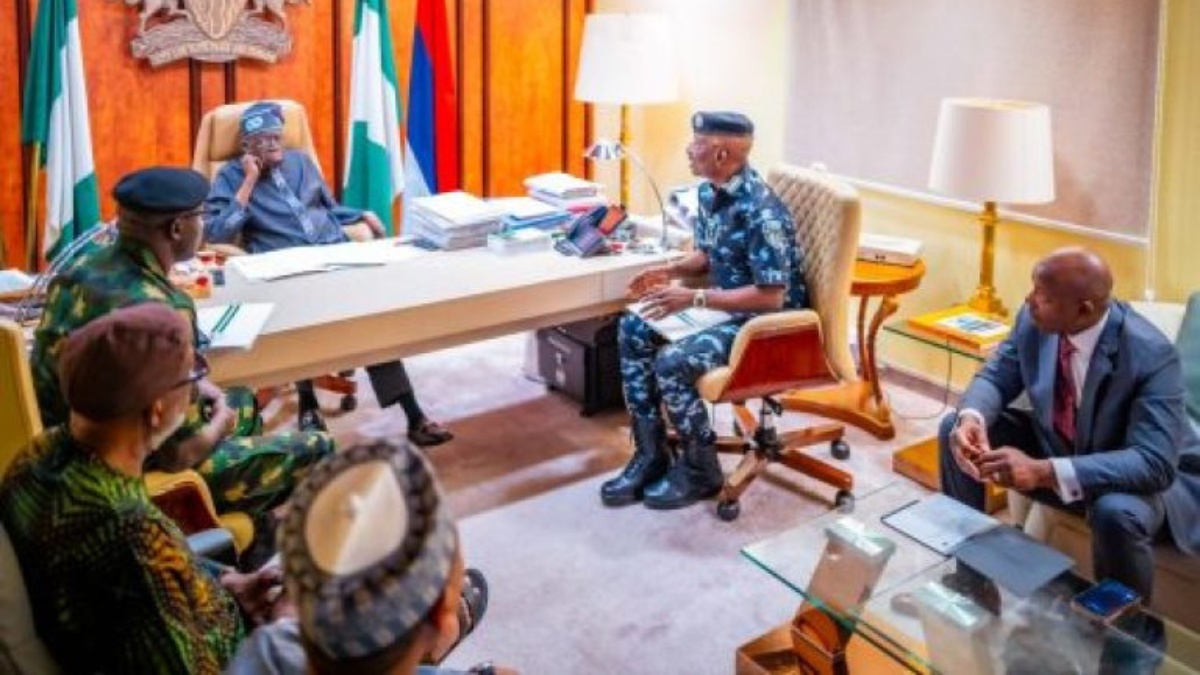
President Bola Tinubu held an emergency meeting with service chiefs in Aso Rock
As Nigeria struggles to convince the United States and the global community that it is serious about defeating terrorism, a fresh wave of deadly attacks in the past week has once again exposed the fragility of the nation’s security architecture. Analysts, community leaders and security experts warn that time is fast running out for President Bola Ahmed Tinubu and his government.
From the abduction of 303 students and 12 teachers in Niger State, to the kidnapping of 25 schoolgirls in Kebbi State, and the attack on worshippers in a church in Kwara, terrorists have continued to show audacity and coordination.
Many more unreported attacks across rural communities paint an even darker picture. Every attack leaves behind a familiar trail: lives cut short, children seized like commodities, villages destroyed, and thousands displaced in their own country. Many now say Nigeria’s territorial space is slowly shrinking.
For over 15 years, successive governments have repeated the same promises, often without matching action. Experts note that the failure to review strategy or muster the required political will has emboldened insurgents. A retired military officer who spoke on condition of anonymity said, “We cannot keep calling these guys rag-tag criminals when they are clearly outsmarting our best-trained officers.” His frustration mirrors that of many security observers who believe Nigeria is fighting yesterday’s war with yesterday’s methods.
The killing of a Brigade Commander in Borno by ISWAP fighters last week has further deepened fear within military circles. Security analysts describe the incident as a “national embarrassment” and a sign that the insurgents are not only stronger, but also more coordinated than ever.
Governors of affected states have also raised the alarm. Kebbi State governor, Mohammed Nasir, lamented that credible DSS intelligence about the schoolgirl abductions was ignored—echoing the same intelligence failures that happened in Chibok 11 years ago. Stakeholders are now asking: Is this negligence, incompetence, or sabotage?
Since 2014, more than 1,548 schoolchildren have been abducted across northern Nigeria despite billions spent on security. Terrorists now control pockets of territories, collect taxes, and run their own parallel governments. Many citizens say this raises a fundamental question: what then is the role of government?
President Tinubu’s decision to cancel foreign trips and summon full military mobilisation is seen as a positive signal. Nevertheless, Nigerians insist that symbolism is not enough. They expect results.
As one security scholar put it, “Nigeria is not asking the President for miracles. We are asking for safety. If the government cannot protect lives, nothing else matters.”



Leave feedback about this