
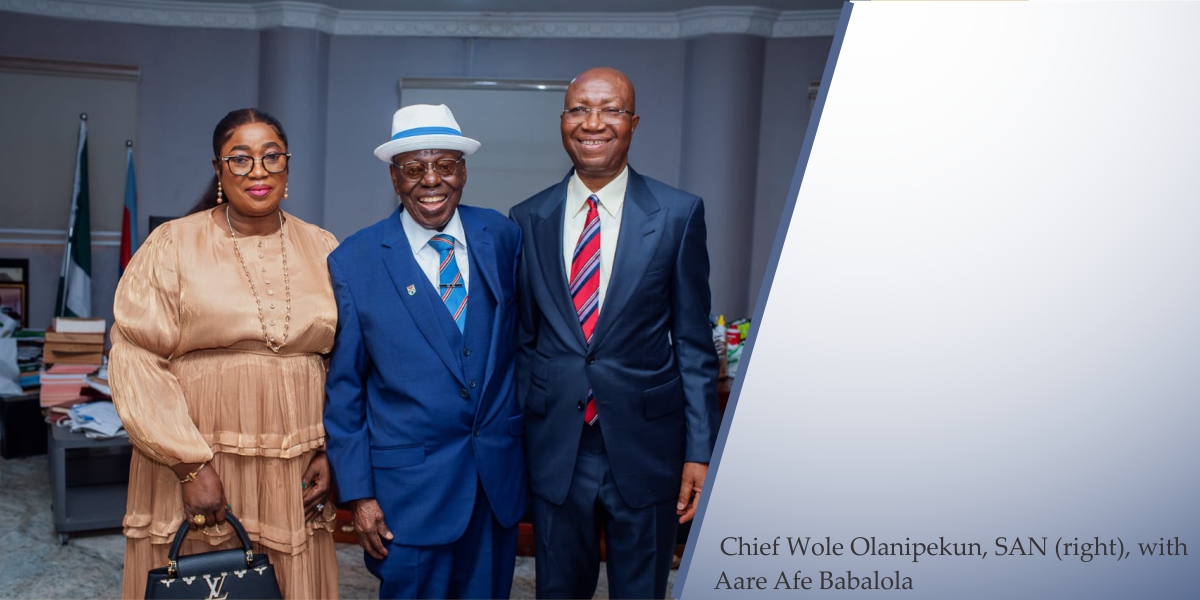
When university students began another two-week wait under the shadow of the latest Academic Staff Union of Universities (ASUU) strike, many Nigerians sighed in resignation: another disruption, another lost semester. But beneath the recurring labour disputes and the decay of the education system lies a deeper fracture — one that prominent jurist Chief Wole Olanipekun, SAN, believes can only be healed by rewriting Nigeria’s Constitution itself.
At the 13th Convocation Lecture of Afe Babalola University, Ado-Ekiti (ABUAD), themed “Nigeria — Yesterday, Today and Tomorrow: The Imperative of a Sober and Definitive Recalibration,” Olanipekun delivered a lecture that reignited debate about governance and education. His argument was both radical and straightforward: Nigeria’s educational decline is not merely about funding or management — it is constitutional.
“Education appears to be on the Concurrent Legislative List,” he said, “yet the Federal Government still calls the shots.” He recalled how, in the First Republic, regional governments drove literacy and institutional expansion without federal interference. Today, however, states “look up to the Federal Government for mere fertiliser supplies,” while schools wait endlessly for central policies and handouts that should have been local.
In a particularly evocative section of his speech, Olanipekun reached back to Nigeria’s golden era of regional development:
“While it remains true that it was the imperialists that cobbled the over 300 ethnic nationalities in Nigeria together without consent… the fact remains that the Regions were thriving, providing the dividends of democracy for their people in education, healthcare, commerce and industry. The Western Region under Chief Obafemi Awolowo launched free, universal primary education in 1955, building teacher-training colleges and expanding secondary schools; the Eastern Region under Dr. Nnamdi Azikiwe established the University of Nigeria, Nsukka in 1960 while steadily raising primary-school enrolments; and the Northern Region under Sir Ahmadu Bello created Ahmadu Bello University, Zaria in 1962, modernising secular and Islamic education side by side. These initiatives, though regionally distinct, collectively sculpted a federated Nigeria that pulsed with promise — until the coupists truncated the federalist dream.”
For him, the collapse of Nigeria’s education system cannot be separated from the “unitary command structure” imposed after the 1966 coup — one that stripped states of initiative and autonomy. This “overcentralisation,” he argued, continues to stifle creativity and accountability across sectors, particularly education.
Olanipekun’s critique went beyond history. He described the 1999 Constitution as “a document that tells lies against itself,” noting that it was never negotiated by Nigerians but “promulgated by the military.” Quoting the late legal titan Chief F.R.A. Williams, he asked, “Where did we, the people of Nigeria, meet?”
He urged the National Assembly to suspend ongoing constitutional amendments and instead begin drafting an entirely new, homegrown charter, “a negotiated document that will pave the way for a new social order.” Piecemeal amendments, he warned, are futile when the foundation itself is flawed. “We cannot continue to live by the 1999 Constitution, which haunts us as a military albatross,” he said.
Olanipekun proposed a transitional period up to 2031, during which Nigeria would operate under a new Constitution. This process, he said, should be guided by a national referendum that allows citizens to “speak in unison on matters of grave national importance.”
His call echoes that of ABUAD founder, Aare Afe Babalola, who has long championed a complete restructuring of Nigeria’s political foundations. “It is now a clear case of either we restructure now, or we may face unplanned reconfiguration in the not too distant future,” Babalola once wrote.
Drawing parallels with other nations, Olanipekun cited France, Switzerland, and Canada, countries that have adapted their constitutions to their histories and diversity. “These nations show that constitutions must reflect a people’s peculiarities,” he said.
For many students weary of strikes, underfunded schools, and policy inconsistency, such constitutional debates may seem distant. But Olanipekun insists that no reform in education can endure without structural recalibration. “We must repair our present, heal and not nurse our wounds, replenish and not deplete,” he declared, invoking the closing lines of Nigeria’s national anthem as a prayer for unity.
As another strike stretches on and universities struggle to reopen, his words echo beyond ABUAD’s hall: perhaps Nigeria’s classrooms cannot be fixed until the foundation of the republic itself is rebuilt.


Leave feedback about this