

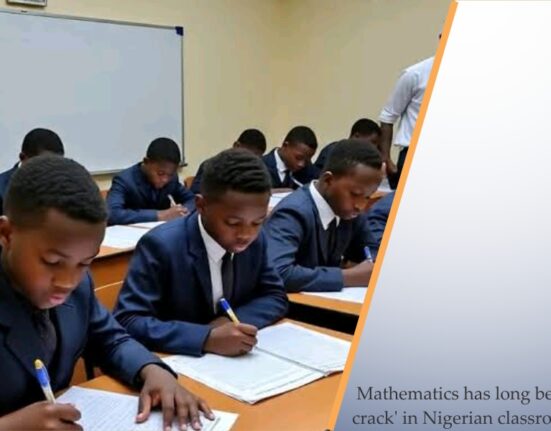
Between 2018 and 2024, state governments, parents, and guardians collectively spent over ₦122 billion on the West African Senior School Certificate Examination (WASSCE), yet the results have remained poor, prompting renewed concerns about the state of Nigeria’s education system.
In Lagos State alone, 31,596 out of 56,134 public school students failed the 2024 WASSCE despite the government spending ₦1.57 billion on examination enrolment.
That means more than half of the candidates, 54.3%, failed the examination.
The pass rate of 45.7% reflects a continuing decline in student performance despite rising investments.
This is not a one-off issue.
The 2023 WASSCE saw a similar failure rate of over 52% despite the government hiring 4,300 new teachers.
In contrast, 2021 and 2022 saw significantly lower failure rates at 21.3% and 23.64%, respectively. However, the general trend since then points to a troubling decline.
Nationally, the 2024 WASSCE saw 18 million candidates, with a pass rate of 72.12%.
While this sounds encouraging compared to Lagos’s performance, it is still a 7.69% drop from 2023.
The pass rate is calculated based on students achieving at least five credits, including English and mathematics.
Alarmingly, many results were withheld due to suspected malpractice.
Looking back, the cost of the examinations has steadily increased.
In 2018, with the fee at ₦13,950 and 1.57 million candidates, ₦22.02 billion was spent. By 2021, the cost had risen to ₦18,000, with ₦28.08 billion spent to support 1.56 million students.
By 2022, expenditure climbed to ₦28.8 billion as more students registered.
While some years saw better outcomes, like 2020, when 86.99% passed despite the COVID-19 disruption, the overall picture is one of inconsistency and decline. In 2019, 64.18% passed, up from 49.98% in 2018.
Experts attribute the high failure rates to several factors, including a lack of qualified teachers, inadequate infrastructure, a shortage of teaching materials, and weak foundational primary education.
Students are often burdened with home responsibilities, suffer from poor parental involvement, and attend under-resourced schools with untrained teachers.
Beyond schools, the government’s failure to prioritise and fund education reforms has worsened the situation.
Inconsistent policies, inadequate teacher training, and poor monitoring persist as hindrances to the system’s effectiveness.
Socioeconomic factors, such as poverty, also impact students’ ability to concentrate on their studies.
Education professionals recommend practical solutions, such as improved teacher training, better facilities, curriculum reform, and smaller class sizes (with no more than 40 students per teacher).
They also call for increased parental engagement and ongoing student assessments to track progress and fix learning gaps early.
Meanwhile, examination malpractice remains rampant despite harsh penalties, including result cancellations, school bans, and a four-year jail term.
Sadly, even parents are often complicit in these dishonest practices, further eroding the value of education in the country. Experts and stakeholders stress that unless drastic steps are taken, the high cost of examinations will continue to yield poor results, and Nigeria’s education system will continue to deteriorate, wasting not just money but also the future of millions of students.
Leave feedback about this