
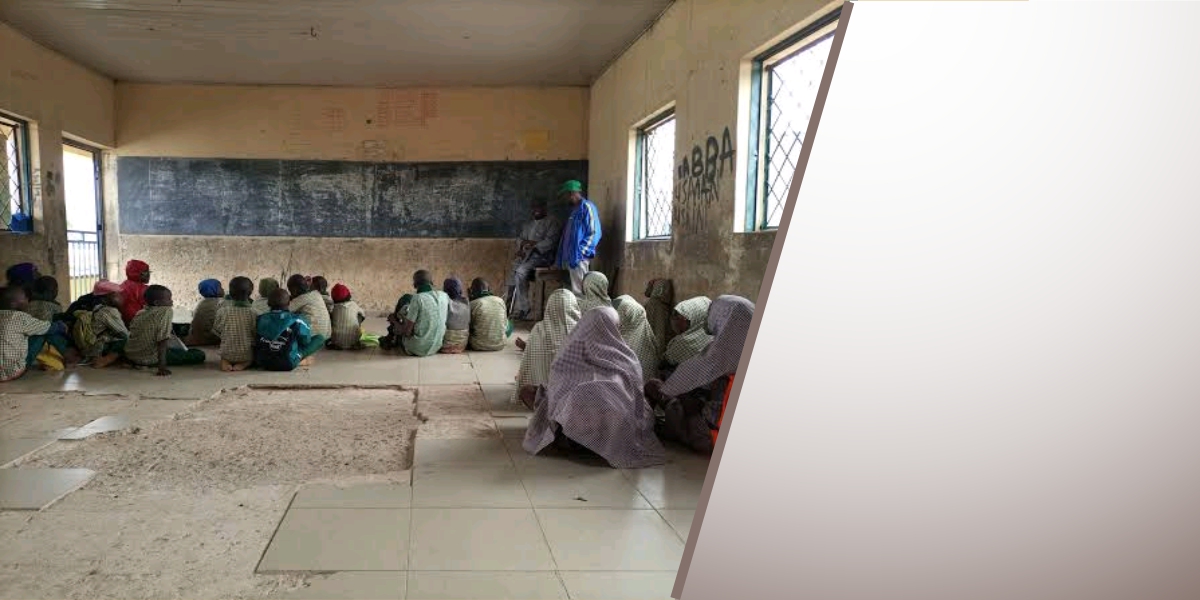
The state of primary education in Nigeria is nothing short of a national disgrace. At a time when education should serve as the foundation for development, millions of Nigerian children are being denied even the most basic learning conditions. State governments, entrusted with this critical responsibility, have shown a disturbing lack of commitment, leaving classrooms to crumble and futures to dim.
In many schools, children still sit on bare floors or under trees because there are no chairs, desks or proper classrooms. In June this year, Kano State Governor Abba Yusuf admitted that more than 4.7 million pupils in his state were forced to learn on the floor. Such revelations would be shocking anywhere else in the world, but in Nigeria, they have become a grim norm.
The crisis is not just about infrastructure. It is about access. UNICEF estimates that 18.3 million Nigerian children are out of school – the highest figure in the world. Insecurity, poverty, and government negligence fuel this crisis. The United Nations reports that in 2024 alone, around 14,000 schools in West Africa and the Sahel were closed due to insecurity, with Nigeria bearing a large share of the burden.
The North-East and North-West remain the most severely affected. States such as Bauchi, Jigawa, Kano, Katsina, Kebbi, Sokoto, Yobe and Zamfara lead in out-of-school children, with literacy levels trailing behind national averages. Armed groups have even turned schools into targets, with over 1,300 children reportedly recruited into their ranks in 2024.
However, the tragedy is not only external. It is worsened by the reckless governance of Nigeria’s political elite. The Universal Basic Education programme, launched in 1999, aimed to ensure nationwide access to quality primary education. However, the scheme has been crippled by corruption and inefficiency.
Between 2020 and 2024, more than ₦135 billion in matching grants meant for schools went unused because state governments either failed to provide their share of counterpart funding or simply mismanaged resources. As of November 2024, 34 states and the Federal Capital Territory had yet to access their grants, even as many governors found funds for luxury convoys and political patronage. Today, about ₦68 billion in intervention funds remain dormant.
This is a betrayal of Nigeria’s children. It is also a betrayal of the nation’s future. While children in China and other parts of the world enjoy classrooms equipped with computers, internet access, and multimedia learning tools, millions of Nigerian pupils cannot access even basic amenities, such as chalkboards or clean toilets.
Accountability must be enforced. Governors who squander education funds should not be shielded by immunity or political patronage; they should be held to account by anti-graft agencies, even after leaving office. Local governments, too, must reclaim their statutory responsibility for primary schools, rather than leaving communities at the mercy of underfunded public institutions and exploitative private operators.
Civil society and the National Orientation Agency have a duty to promote a cultural shift – to remind Nigerians that education is not a luxury, but a necessity. Teachers must be recruited, adequately trained, and provided with incentives to stay in the classroom. Above all, education must be adequately funded, free, and compulsory.
Suppose Nigeria continues to deny millions of children the right to learn. In that case, it condemns them to a lifetime of poverty and insecurity, while robbing the nation of its most significant potential – an educated generation capable of driving progress. The crisis of primary education is not just an education problem; it is a national emergency. Furthermore, until leaders treat it as such, Nigeria will continue to mortgage its future.

Leave feedback about this