
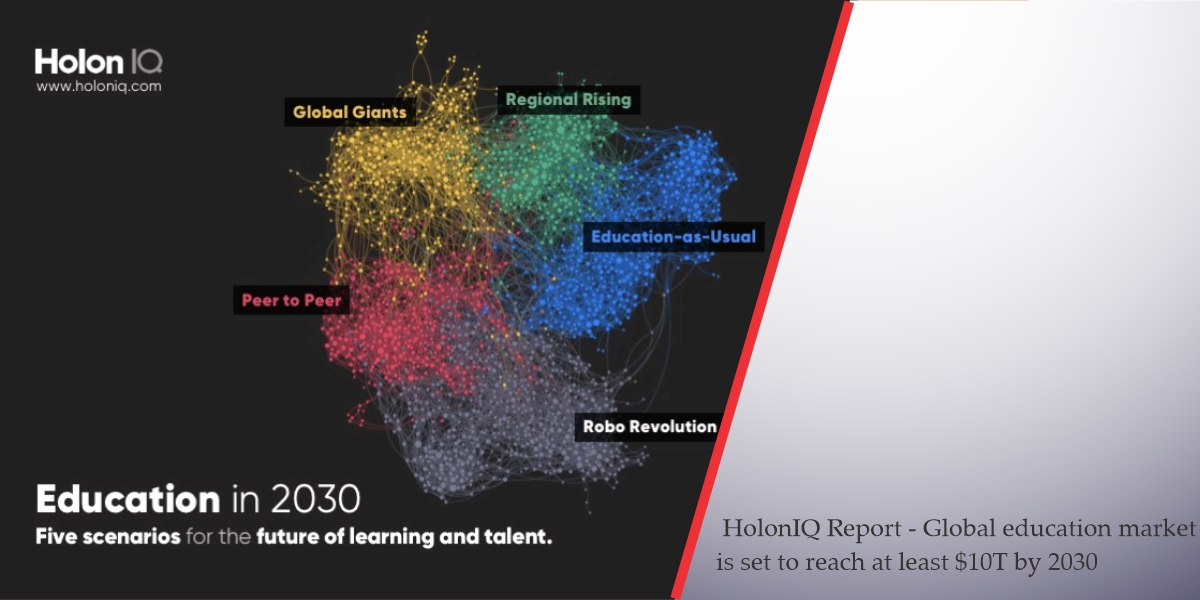
When the globally renowned research firm HolonIQ released its 2030 education report, it painted a bold picture: a $10 trillion global education industry by the end of the decade, shaped by five possible scenarios. From “Education-as-Usual” to “Robo Revolution,” the report paints a picture of a world where technology giants, artificial intelligence, and new networks dominate the delivery of knowledge.
However, how do these scenarios fit into Africa’s classrooms, many of which still struggle with poor infrastructure, teacher shortages, and widening inequality?
Education experts across West Africa argue that while the report is visionary, it overlooks a critical component—community-driven innovation.
“HolonIQ talks about global giants and AI tutors, but they do not see what is happening in villages where mothers, religious leaders, and teachers are blending tradition with technology to keep children learning,” said Precious Obi, a Nigerian education innovator. “That is the sixth scenario they missed.”
HolonIQ’s projections indicate that Africa will deliver nearly 90 million more primary school graduates by 2030. However, the statistics hide deep inequalities. Across African countries, including Nigeria, Ghana, and Sierra Leone, many schools continue to operate without access to electricity, laboratories, or internet connectivity. Nevertheless, these challenges are also breeding creativity.
In rural Nigeria, for instance, community-led solutions such as Allo, an offline audio-visual learning device, and STEM Tree, which ties science lessons to familiar cultural practices, are bridging gaps where government structures fail.
“This is the story you do not hear in global reports,” said Dr Mensah Agyeman, an education policy researcher in Ghana. “Innovation here does not always look like Silicon Valley apps. It is often small, affordable, and built around community trust.”
One of HolonIQ’s scenarios imagines a future dominated by multinational technology companies. However, educators warn that this could undermine cultural values.
“When big tech brings solutions into African classrooms, they often fail to localise,” observed Dr Fatima Danjuma, a lecturer in Kaduna. “In northern Nigeria, where girls’ school attendance is already low, foreign solutions rarely succeed unless they work with existing community networks like women’s cooperatives or religious groups.”
Kenya provides a good case study. Its digital learning project, which introduced tablets to schools, initially faced resistance. It only began to succeed when local teachers adapted the devices for offline use in local languages.
HolonIQ also highlights peer-to-peer learning powered by blockchain credentialing. In Africa, peer learning already thrives, but in different ways. In many communities, knowledge is passed down through extended families or apprenticeship systems.
“What matters is community validation,” explained Obi. “In some cases, a girl showing her mother she can use scientific methods to improve crop yield is a stronger credential than a digital badge from a global platform.”
By 2030, Africa will host the world’s youngest population, with one in four workers globally coming from the continent. The challenge is whether educational models will empower them to compete globally while staying rooted in local realities.
As Agyeman puts it: “The real future of education will not be imported. It will be invented in African classrooms from Lagos to Accra to Freetown, by people who know their communities best.”
The message is clear: while global reports offer frameworks, Africa must write its own script for education in 2030, one that combines tradition, technology, and community power




Leave feedback about this